
FREQUENTLY ASKED QUESTIONS
Scope determines timeline. A focused operational system is often production-ready in 3–5 months; multi-module enterprise platforms run longer. You receive a phased delivery plan — with working software at each phase — before development begins, not a single end date.
Most engagements reallocate time, not headcount — automation removes the manual layer so your team can focus on judgment-based work. Where headcount impact is a genuine consideration, we surface it during the audit phase, not after deployment.
In most cases, yes — through database-level integration, file-based exchange, or middleware, depending on what the legacy system supports. We assess this during discovery before quoting the work.
The right choice depends on your existing stack, compliance requirements, and team familiarity — we assess this rather than defaulting to one provider. All three platforms power our own products in production.
Configuration works until your process outgrows the platform's data model — at which point every workaround adds licensing cost and complexity. Custom CRM removes that ceiling entirely; Nexora CRM is proof of what we build when the ceiling is removed.
The team works as an extension of yours — your processes, your standups, your tools — with direct communication rather than a project manager relaying requirements through a vendor layer.
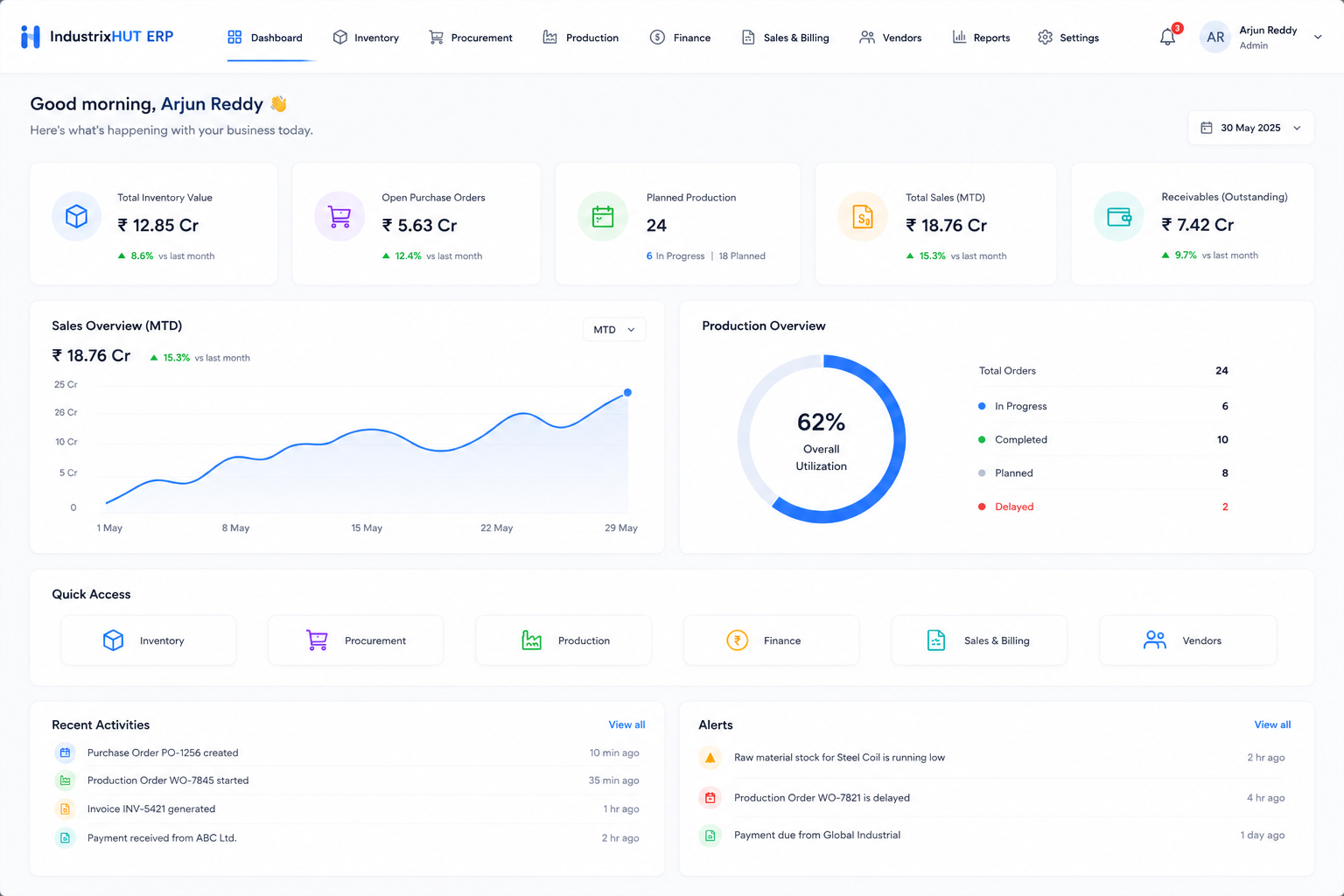
Enterprise ERP platforms are built to serve the average business in your industry — the more your operations deviate from that average, the more expensive and fragile the configuration becomes. Industrix ERP, our own in-house platform, is the proof point for what a purpose-built alternative looks like at production scale.
Off-the-shelf HR platforms are priced and structured around per-employee licensing that scales against you as you grow, and their workflows assume a generic organizational structure. HR Workify, built and operated by our own team, is the reference point for what a purpose-built alternative delivers.
Depends on performance requirements, device-specific features needed, and budget — we recommend based on your use case rather than a default preference, and will explain the tradeoffs before you commit.
Yes — HR Workify, Nexora CRM, Docvoult, TestGenie, and others are commercially operated products built by this team, not case studies from client work. Every architectural and pricing decision has already been made once, at our own risk.
Validation with stakeholders or real users is part of the process for any application with meaningful user-facing complexity — decisions aren't assumed to be correct without testing.
Web development here refers specifically to browser-based platforms — portals, transaction systems, operational tools. Where the same underlying system also needs deep backend logic across mobile or other channels, that broader scope falls under Custom Software Development.
Both. Most clients start with a full-funnel programme. Focused retainers are available once the core engine is in place.
No reputable SEO partner does. We commit to a technical and content programme, transparent reporting, and keywords chosen for commercial value.
LinkedIn, Instagram, Facebook, YouTube, X and WhatsApp/community channels — selected against your audience, not against a default package.
Google Ads, Meta, LinkedIn, YouTube and remarketing. Platform mix is based on your ACV and buyer journey.
Yes. We start with a voice and proof brief, then iterate against your reviews until it sounds like you.
HubSpot, Mailchimp, Klaviyo, Brevo, ActiveCampaign and custom SMTP/CRM setups. We will recommend based on your stack, not a partnership.
No. Logo is one artefact. We deliver strategy, identity, verbal brand and the kits your team will use.
No. Performance buys leads. Promotion builds memory and preference so those leads become cheaper and easier over time. We often run both.
No. We guarantee a professional programme, targeted outreach and assets journalists can use. Coverage is earned.
Only when they violate platform policy or law. Legitimate criticism is handled with response, context and a stronger public record — not fake takedowns.
We recommend against your estate and budget. We are not locked to a single box vendor.
Depends on your documents, devices and industry. We recommend one and will not force a stack you will fight every day.
You do, in full. There is no licensing structure, no revenue share, and no dependency on IT WEBHUT to keep the system running.
Phase 1 is a process audit. We prioritize by measurable impact and won't automate a workflow that's fundamentally broken — we'll flag it for redesign first.
We design a data mapping and transformation layer that reconciles differences in format, structure, and business logic — rather than forcing one system to conform to another.
Cost-efficiency is designed into the architecture — right-sizing, auto-scaling, and reserved capacity planning — and monitored on an ongoing basis, not audited once a year after costs have already grown.
Yes — integration with marketing automation, ERP, billing, and support platforms is standard scope, not an add-on.
Yes. You review profiles and can request changes to team composition before and during the engagement.
Yes — multi-entity, multi-currency, and multi-location architecture is designed in from the start where required, not bolted on later.
Yes — multi-jurisdiction payroll rules, tax compliance, and labor law requirements are engineered in where your operations require it.
App store submission, review, and compliance requirements are managed as part of delivery, including handling rejections and resubmissions.
Data isolation, per-tenant configuration, and infrastructure that scales per customer without a full rebuild per client — a fundamentally different architecture than a single-tenant internal tool.
Yes — most engagements are redesigns of live products, sequenced to minimize disruption to existing users during rollout.
Yes — auditing and improving an existing codebase is common work, including cases where the original build came from another vendor.
Paid channels can produce leads within weeks. SEO and brand compounding typically take 90–180 days. You get a timeline against each channel before we start.
Technical wins can appear in weeks. Competitive terms typically need 3–6 months. We sequence quick wins first.
We produce strategy, copy, design and short-form video. Scheduling-only retainers are available if you already have a creative team.
Yes. We work inside your accounts so you retain ownership of data, pixels and history.
That is the default. Ranking pages that cannot be sent to a prospect are incomplete.
No. Email marketing is campaigns and automation. Business Email Solutions covers Google Workspace and Microsoft 365 mailboxes.
Yes. Most engagements are identity and messaging systems on an existing name.
Yes. We can work within an existing identity, or flag where the identity itself is the constraint.
Yes — digital PR and high-quality mentions support brand search and authority when they are done properly.
Listings and review response can move in days. SERP composition for competitive brand queries typically takes months of consistent work.
Yes. Most engagements are partnered with internal IT, not a replacement for them.
Not if we plan the migration. History, calendars and contacts are in scope unless you explicitly want a clean start.
Yes — integration is designed in from the architecture phase, not added afterward. We've connected custom builds to Industrix ERP, Nexora CRM, Salesforce, SAP, and NetSuite, among others.
Fully documented and fully owned by you. You can see exactly what triggers a decision and change the logic without depending on us.
Integrations are monitored, and we maintain them proactively rather than waiting for a failure to be reported by your team.
Migrations are sequenced to minimize or eliminate downtime, using parallel-run and phased cutover strategies appropriate to your risk tolerance.
Adoption is faster than platform migrations because the system is built around your existing process, not a generic sales methodology your team has to relearn.
Team size is designed to flex with project phase — ramping up for active development and scaling down during maintenance periods, without renegotiating a new contract each time.
Migration is phased and sequenced against your fiscal calendar and operational risk tolerance, with parallel-run validation before full cutover.
Role-based access, encryption, and audit logging are built into the architecture from day one — HR data requires this by default, not as an upgrade.
Yes, where the use case requires it — offline data capture with background sync is a common requirement for field and logistics apps.
Usage-based and subscription billing infrastructure — plans, metering, upgrades, dunning — is built in from the architecture phase, not retrofitted after customers start asking for it.
Design systems, component libraries, and developer-ready specifications, structured for direct implementation rather than requiring translation work from your engineering team.
Performance testing runs under realistic load scenarios, not just functional QA, and infrastructure is sized for actual traffic patterns rather than best-case assumptions.
Yes. We integrate with what you already run — and rebuild only the parts that are blocking conversion.
Yes. Most SEO retainers start on existing sites. If the architecture is blocking growth, we will say so.
Yes. Ghostwriting, positioning and a posting system for leadership profiles is a core B2B offering.
It depends on market and ACV. We will not recommend a budget that cannot produce statistically useful data.
Yes — short explainers, founder clips and product walkthroughs when they serve the funnel.
Yes — templates, lists, suppressions and key automations, with a cutover plan that does not double-send.
Identity can ship first. Website and UI application are available as a connected engagement.
Yes — digital is the core, with print, event and partner activation when they serve the plan.
No. Growth-stage companies with a real story are often the best PR clients. We will not take a retainer if there is nothing to say.
No. That is a policy and legal risk. We build genuine ask-and-respond operations.
Related but different. Network security is identity, infrastructure and perimeter. Application security is how the software is built. We do both.
Usually yes — authentication, reputation and content are the first three checks. We will tell you if the domain itself is burned.
Development runs in two-week sprints specifically so priorities can shift without derailing the project. Scope changes are reviewed and re-estimated at the start of the next sprint, not treated as change-order friction.
Only the data required for the specific workflow, scoped and access-controlled from day one. Compliance and audit logging are built into the architecture, not added after a security review.
Both, depending on the use case. Real-time is used where operational decisions depend on current data; scheduled syncs are used where near-real-time is sufficient and reduces system load.
Architectures are built to support SOC 2, HIPAA, GDPR, and industry-specific requirements as needed — compliance is a design input, not a retrofit.
Real-time pipeline visibility, revenue forecasting, and rep-level performance reporting are built around your specific KPIs, not a fixed template.
You do, in full — identical to any other IT WEBHUT engagement.
Yes — integration with accounting platforms, payroll, banking, and tax systems is standard scope.
Yes — data migration and validation against your existing records is a defined delivery phase.
Performance testing under realistic load and device conditions is part of QA, not something discovered after launch through user complaints.
Our scope is the product engineering — architecture, build, and scale. We can advise on product decisions that affect engineering cost, but go-to-market strategy sits outside our delivery scope.
Success is measured against defined metrics — task completion time, conversion, support ticket volume — agreed before the redesign begins, not judged subjectively after launch.
OWASP-aligned security review and hardening is part of the standard delivery process, not an optional add-on discovered necessary after launch.
Monthly commercial reports plus weekly optimisation notes: spend, qualified leads, cost per opportunity, and what we are changing next.
Yes — Google Business Profile and location pages for local demand, plus national/category SEO for broader markets.
Profile conversions, qualified inbound, content that sales can use, and paid efficiency — not likes in isolation.
Yes. Most retainers start with a rebuild, not a blind scale-up.
Volume follows strategy. A typical retainer is a mix of long-form pages, case studies and distribution assets — not a vanity post count.
SPF/DKIM/DMARC, list hygiene, cadence control and complaint monitoring. We will not blast a cold scraped list.
Positioning cannot be outsourced entirely. We need decision-makers in discovery and direction workshops.
Launches are typically 8–16 weeks including sustain. Always-on retainers run quarterly.
No. Social is owned distribution. PR is earned credibility. They should be planned together.
Crisis is one reason. Most retainers are preventative — keeping the public record accurate as you grow.
Monitoring and retained response are available. 24/7 SOC can be delivered with a specialist partner when the estate requires it.
That is Email Marketing. Corporate mail and marketing automation should not share the same sending reputation blindly.
We offer structured post-launch support and an evolution roadmap. Most enterprise clients retain us for ongoing iteration rather than treating launch as an endpoint.
Yes. Automation and AI layers are built to sit on top of your existing systems — including Industrix ERP and Nexora CRM — rather than requiring replacement.
Yes — encryption, authentication, and access control are engineered into every integration point, with full audit logging.
Not necessarily. We can hand off with full documentation and training, or continue managing infrastructure under an ongoing engagement — your call.
Yes — data migration and validation is a defined phase in the delivery process, with reconciliation before cutover.
Overlap hours are structured around your working hours, with documented handoff processes for asynchronous work outside overlap windows.
Financial, operational, and regulatory reporting are built around your specific compliance obligations, with full audit trails.
Yes — payroll and headcount data are designed to flow into finance and ERP systems, including Industrix ERP, without manual export/import.
Yes, typically — mobile apps are built to connect to your existing systems, including Industrix ERP and Nexora CRM, rather than operating as a standalone silo.
Yes — re-architecture engagements for products that have outgrown their original technical foundation are common work for us.
Yes — WCAG accessibility standards are a default design input for enterprise and public-sector work, not an optional add-on.
Yes — integration with existing business systems, including Industrix ERP and Nexora CRM, is designed in from the architecture phase.
Growth systems need a runway. Typical retainers run quarterly so SEO, creative testing and paid learning have time to compound.
Yes. Without access we can audit, but we cannot ship the fixes that actually move rankings.
Yes. Organic and paid social are more effective when they are planned together.
We connect ads to CRM outcomes and use sales feedback to exclude junk traffic.
Yes. Updating pages that already have authority is often the highest-ROI work we do.
Yes. Strategy, copy, design and automation are one engagement.
Yes — stationery, signage and event kits as part of the toolkit when they are in scope.
Yes. If promotion does not reach the sales conversation, it is incomplete.
Yes. We prefer to install a protocol before you need it. Rapid-response support is available when something is already in motion.
Yes. Founder and CXO search is often as important as the corporate SERP.
Hardening is sequenced. MFA and access changes are rolled out with communication, not a surprise lockout.
Yes. Retained admin covers offboarding, DNS, licensing and quarterly security reviews.
Fixed-scope pricing for well-defined projects; time-and-materials for engagements where discovery will shape the build. You'll know which model applies before any commitment.
Ongoing model monitoring and retraining is part of delivery, not a separate line item you have to request later.
Integration is designed to protect your existing infrastructure investment, not replace it. We've connected Industrix ERP, Nexora CRM, and third-party platforms across manufacturing, finance, and logistics environments.
Backup, failover, and recovery procedures are defined and tested as part of the architecture, with documented recovery time objectives — not assumed.
Yes — CRM builds are designed for cross-device access as standard, not a separate mobile project.
Timelines depend on the specific skill set required, but most engagements begin within two to four weeks of scope confirmation.
Structured post-launch support and an iteration roadmap are included — most clients retain us for ongoing evolution as the business scales.
Self-service portals for leave requests, document access, and performance reviews are standard scope, reducing HR administrative load directly.
Ongoing OS compatibility updates, bug fixes, and feature iteration — mobile platforms require continuous maintenance as Apple and Google update their operating systems.
Typically a phased structure: fixed-scope for MVP or defined releases, transitioning to an ongoing engagement as the product scales and requirements evolve.
Yes — design and engineering sit under one accountable team, which removes the handoff gap that causes most designs to be poorly implemented.
Structured post-launch support during the period when real usage reveals issues testing didn't catch, plus an ongoing option for continued development.
Still have questions?
Contact Support